How an Air Source Heat Pump Works — Following the Heat Into a Bristol Home
Last reviewed: 2 October 2026
Follow a unit of heat from the air outside a Bristol home, through the heat pump's refrigerant cycle, and into your radiators and hot water — and see why the system can deliver three to four times more heat than the electricity it uses.
The idea in brief
A heat pump works like a fridge in reverse. A fridge pulls heat out of its interior and dumps it at the back; a heat pump pulls heat out of the outside air and delivers it into your home. Electricity runs the pump and fan, but most of the heat comes free from the air.
The easiest way to understand it is to follow some heat on its journey on a typical January morning in Bristol, when it’s about 4°C outside.
Stage 1: outside air meets a very cold liquid
The fan in the outdoor unit draws air across a coil of thin metal fins. Inside the coil runs a refrigerant, a fluid that boils at a very low temperature, well below freezing.
Air at 4°C is far warmer than that refrigerant, so heat flows from the air into the coil. The refrigerant absorbs it and boils into a gas. The air leaves the back of the unit a few degrees colder than it arrived.
This is why heat pumps still work in winter: the air doesn’t need to feel warm, it only needs to be warmer than the refrigerant.
Stage 2: squeezing the gas makes it hot
The refrigerant gas is now carrying heat, but it’s still cool. The compressor, the part that uses most of the electricity, squeezes it into a much smaller volume. Compressing a gas raises its temperature sharply, the same effect that warms a bicycle pump as you use it. The refrigerant leaves the compressor hot enough to heat water.
Stage 3: handing the heat to your heating water
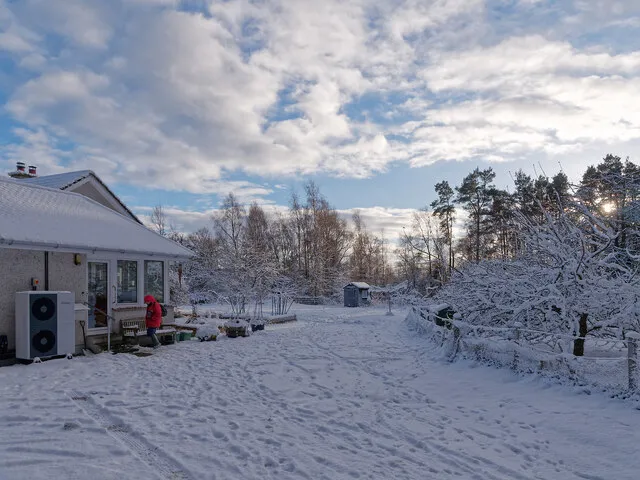
The hot refrigerant passes through a heat exchanger, where it gives up its heat to the water in your central heating. In the monobloc units fitted in most Bristol homes, this happens inside the outdoor unit, and heated water then travels indoors through insulated pipes. As it loses heat, the refrigerant condenses back into a liquid.
Stage 4: reset and repeat
The liquid refrigerant passes through an expansion valve, which drops its pressure and temperature right back down, ready to absorb heat from the air again. The cycle runs continuously while the heating is on.
Inside the house: radiators and hot water
The warm water goes two ways:
- To your radiators, usually at 45–50°C rather than the 70°C a gas boiler uses. Radiators feel warm rather than hot, and the system runs for longer periods to keep the house at a steady temperature. That’s why some rooms need larger radiators.
- To the hot water cylinder, which stores water for taps and showers. Bristol’s water is hard, so a cylinder with a heat pump-rated coil helps it keep reheating efficiently.
Why it uses so little electricity
The electricity only drives the compressor, fan and pumps. The heat itself comes from the air. On a mild Bristol day, a heat pump might deliver four or five units of heat per unit of electricity; on a frosty one, nearer two and a half. Over a whole year, a well-designed system in Bristol typically averages 3.2–3.8. This seasonal figure is called SCOP — see SCOP and COP explained.
Two features keep that number high:
- Weather compensation automatically lowers the water temperature on milder days, when less heat is needed. See flow temperature.
- Defrost cycles clear the frost that forms on the outdoor coil in damp, near-freezing weather — a regular event in Bristol’s winters. See defrost cycles.
In summary
Air warms a cold refrigerant, a compressor concentrates that heat, a heat exchanger passes it to your heating water, and the cycle repeats. It’s the same technology as your fridge, scaled up and turned round.
Next: what an air source heat pump is, and whether it suits your home.
See what a heat pump would look like in your Bristol home
The mechanism is the same in every UK home; the design is specific to yours. Our team carries out a free in-home survey including a full room-by-room heat-loss calculation, identifies the system size and configuration that fits your property, and provides a written quote with the £7,500 BUS grant already deducted.
You'll see the actual figure you'd pay — not an estimate — and the projected efficiency for your specific install.